
Axioms for Reliable ML Apps, Part 2
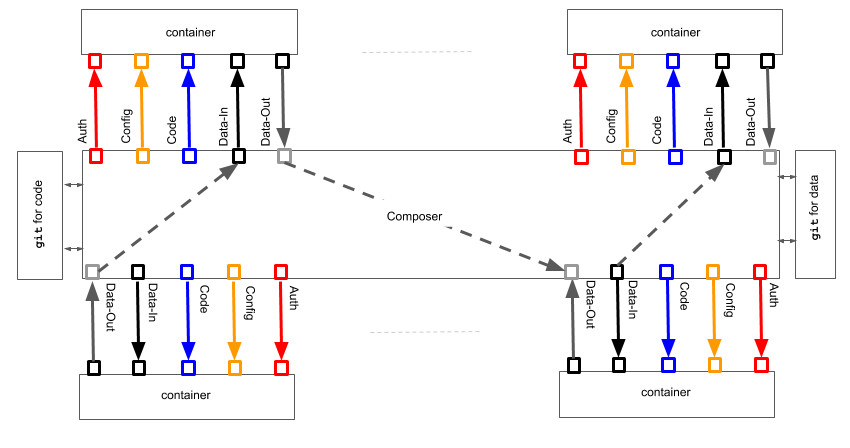
In part 1, I described the goals an ML app should satisfy if it is expected to have a useful shelf life. In this part, I propose a set of axioms that can help app developers focus on problem solving rather than data administration and operational plumbing.
The architecture below is intentionally concrete but incomplete. It is a reference pattern, not a finished product.
Axioms
- Data is a resource and must have a URI. The URI may come from a physical file location, a commit identifier, or a lineage-aware reference that resolves to truth-on-disk.
- Data must resolve to truth-on-disk. Some data must be persistent and permanent; otherwise auditability is impossible.
- There must be a default logical data container. A DataFrame is a good choice. Structured and unstructured data, including text, spatial, temporal, and graph data, can often be represented as DataFrames.
- Data drivers are part of executable code. Drivers are the entry and exit points. They transform storage structures into computation structures and complain when data does not fit intent.
- A micro app serves one reusable purpose well. It may use primitive functions internally, but it should expose one clear functional objective.
- A micro app is a host. It has input ports for data, config, code, and optionally auth. It produces data as output.
- An ML app is a composition of micro apps. Larger apps emerge from smaller executable units.
- Composition topology is a DAG. Nodes are micro apps. Directed edges represent data flow.
- Execution is event-driven. A micro app runs only when upstream dependencies are available.
A Reference Pattern
An ML app can be modeled as a multi-container, event-driven microservice application. Computational dependencies are specified as a DAG. Each micro app is a self-contained executable block with a well-defined purpose. Code, config, and data are all versioned and tagged.
A concrete realization could look like this:
- A micro app is a Docker container.
- The app DAG is specified using Docker Compose or a similar orchestration layer.
- Data endpoints are Docker volumes or follow a data-container pattern.
- Git versions code.
- A data-versioning tool versions data.
This framework enables several useful properties:
- Scalability: if each container can scale, the app can scale.
- Interoperability: different micro apps can use different environments. Data crunching can happen in Spark/Scala while modeling happens in Python/scikit-learn.
- Fast delivery: data scientists can ship production-ready code more directly.
- Repeatability: code, data, image build configuration, and orchestration commits can be pinned.
- Auditability: code, data, and config are tagged, versioned, and traceable.
- Recoverability: DAG execution allows incremental recovery from failures.
- Reconfigurability: a changed model is another DAG or a changed node in the DAG.
- Testability: evaluation can itself be a micro app, enabling A/B testing and model comparison.
What Is Still Missing
This architecture has gaps. Tooling is incomplete. Many operational details still need to be tried and refined. But the pattern is useful because it makes the moving parts explicit: data, code, config, auth, execution, lineage, and composition.
Future topics naturally follow from this architecture:
- the USB-for-ML metaphor;
- DataFrame as the default data pin;
- micro apps in more detail;
- best practices for modularizing data science workflows;
- data science grammar; and
- productivity tools and services for ML app development.
This article remains opinionated and provisional, but its purpose is to surface the design problems around building durable data products.